One of the realities of a high-performance, non-mass-produced kayak like the Ringer is that you may not have access to one in your exact size, right where you paddle. Unlike mass-produced plastic boats that are stocked broadly at dealers and schools, Apex kayaks are built in smaller numbers and placed intentionally. Many paddlers are able to connect with an Apex team member or ambassador to see and try a boat — but availability can vary by region and by size.
That raises a fair and common question:
How do you know if the boat is really as good as it sounds? How do you know if you'll like it — or even love it — if there isn't an Apex team member near you with the boat in your size?
What I Can Share From Experience
This is an easy question for me to answer because I've lived with this boat at every stage of its life. I've spent countless hours designing, prototyping, redesigning, and paddling the Ringer. I'm also around owners constantly — teaching, filming, and watching how this boat changes their paddling over time.
What follows isn't hype. It's what paddlers consistently experience once they get into one — whether they first paddled it through a demo, borrowed one from a team member, or took the leap without trying it first.
The Most Immediate Difference: Weight
No matter who you are or how you paddle, the first thing you will notice is weight.
The Ringer is typically 20–25+ pounds lighter than a comparable plastic kayak. That difference shows up everywhere — before, during, and after you paddle.
If you want a simple way to understand what that feels like before ever touching a Ringer, try this:
- Take a 20–25 lb weight or dumbbell
- Carry it with your current boat
- Load and unload your boat with that extra weight
- Walk to the river with it
If that added weight feels annoying or exhausting, you've just experienced the relief you'll feel when that weight is gone.

What That Weight Reduction Does On the Water
Weight doesn't just affect carrying — it transforms how a boat paddles.
With the Ringer:
- Acceleration is noticeably faster
- Turning takes less effort
- Boofing feels easier and more precise
A key reason is swing weight — the weight at the ends of the boat. You can feel this difference by placing two weights (10–12 lbs each) in a plastic boat:
- One near the bow
- One near the stern
This highlights how much weight at the ends slows turning. Simply adding weight near the seat doesn't create the same effect. The Ringer's ends are extremely light, which is why it feels so quick and responsive in real whitewater.
The Design: Why It Tracks and Feels Fast
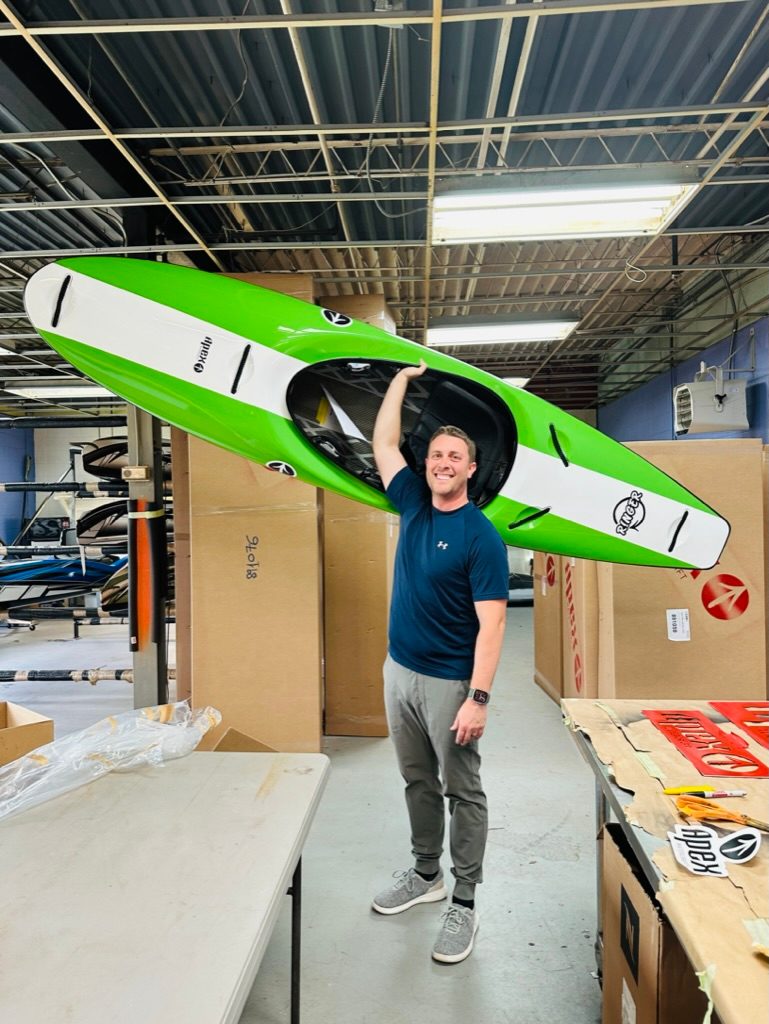
The Ringer's shape is unusual — and intentional. From above, the boat resembles an aerobatic airfoil. From the side, it's essentially half of that airfoil. This does two important things:
First, the stern naturally follows the bow. That wandering-bow feeling — where the front of the boat wants to go one way and the back resists — is dramatically reduced. The boat stays on line with less correction.
Second, it's exceptionally fast downstream. The high, rockered bow stays dry and clears features easily, while the relatively flatter stern resists squatting and unnecessary drag.
A True Planing Hull
Many kayaks claim to have a planing hull, but few are truly planing from end to end. The Ringer is a full planing hull:
- Flat where it needs to be
- Loose and fast on waves
- Easy to spin, grind, and surf
Combined with the low swing weight, the looseness is immediately apparent — without feeling nervous or unpredictable.
Outfitting That Supports Performance
Performance only matters if the boat fits you well. Ringer outfitting is designed for control, simplicity, and adjustability:
- A true bucket seat for stability
- Overhanging hip-pad "hooks" that lock you in without discomfort
- Mini-cell foam that's easy to trim for a custom fit
- Hip-pad shims for lean paddlers who need more contact
- Extremely solid aluminum foot braces that adjust while seated
- A rope-and-cleat backband system originally developed in 2004 — still one of the lightest, strongest, and easiest systems available
Everything is designed to be adjustable, durable, and serviceable.

Who The Ringer Is For
Beginner, intermediate, or expert?
Yes.
If a carbon kayak is within your budget, you are upgrading from a material chosen for mass production to one chosen for performance and experience. There are still situations where plastic makes sense — for example, rivers with constant sharp rock impacts. Outside of that, the decision usually comes down to:
- Your size and proportions
- Your skill level
- How playful or forgiving you want the boat to be
The Ringer comes in multiple sizes so paddlers can tune that balance.

So… How Do You Decide If You Can't Demo One In Your Size?
Sometimes there's an Apex team member near you with the exact boat you need. Sometimes there isn't — yet.
In those cases, it comes down to your personality and priorities. Some paddlers are comfortable trusting the design, the philosophy, and the growing community of owners. Others prefer to wait until they can paddle one locally or travel to connect with a team member.
Both approaches are valid.
What consistently happens, though, is that once paddlers experience:
- Carrying a kayak that weighs half as much
- Loading and unloading without strain
- Paddling something that feels faster and more responsive
…the decision becomes easy.


For me, paddling time is valuable. The Ringer is part of making that time as enjoyable as possible.

See you on the river, Eric Jackson